
Hannah McNamara
Co-Founder & Director of Rescue Initiatives, Communications & Media
Who Rescued Who NS
A Lifelong Calling
Even as a child, Hannah wrote that she wanted to travel the world and rescue animals. Years later, she is doing exactly that.
Hands-On Rescue
From rescue trips and spay and neuter clinics to fostering, transport and finding forever homes, Hannah believes in being there wherever animals need help.
Love in Action
For Hannah, rescue means seeing an animal in need and choosing to do something. As she puts it simply, “Rescue is love in action.”
In the Future...

When I Grow Up...

"I Have Always Felt This Is What I Was Meant to Do"
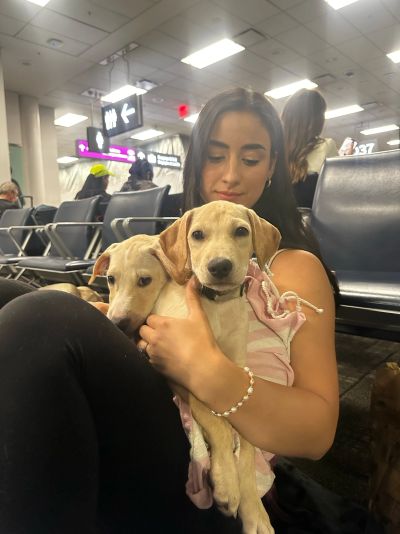
When do you first remember realizing that helping animals was something that really mattered to you?
"I honestly feel like I have known my entire life. Even in elementary school, when we were asked about our future, I wrote that I wanted to travel the world and rescue animals. My parents saved these for me and I still have them. I have always had that feeling that this is what I was meant to do."
Long before Who Rescued Who NS existed, Hannah was already finding ways to get involved. She shared the stories of animals needing help on social media, walked dogs at the SPCA, organized fundraisers, helped with puppy yoga and Pilates events, and participated in dog-walking programs for rescue dogs.
She kept looking for more ways to help.
Then her experiences in The Bahamas changed the scale of what she wanted to do.
Was there an experience that made you think, "I need to do more"?
"After seeing the conditions in The Bahamas and all the animals in the care of the Bahamas Humane Society, it really opened my eyes. Seeing animals live in such crowded, chaotic conditions in the shelter, or worse, on the street full of mange or with broken bones from being hit by cars, while knowing the warmth my dogs feel and the safety they have at home. I want that for all of them."
That experience helped turn a lifelong desire to help into something bigger.
"I knew there was such a need, and I knew I wanted to be in a position where I could make a bigger impact. I wanted to move from helping where I could to creating something where we could actively save more animals and push for change."
The Ones You Never Forget
Ask Hannah about the first animal she personally rescued and there is no hesitation.
His name is Luka.
She adopted him.
"He is my whole world."
But another dog has stayed with her too.
His name was Carlos.
Of all the animals you've helped, is there one rescue that has stayed with you?
"A dog named Carlos. He was absolute skin and bone, terrified and so shut down, living in a crate he couldn't even stand up tall in. I rescued him back to Canada and now he is confident, happy and healthy looking. He really pulled my heartstrings."
Transformations like Carlos's are what Hannah describes as one of the greatest rewards of rescue.
"Seeing an animal go from completely shut down to feeling safe and learning how to trust. It has to be one of the best feelings in the world."
For an animal who has spent its life frightened, neglected, confined, or trying to survive, safety is something that has to be learned.
Watching that happen never gets old.
"It is the most beautiful and rewarding feeling in the world. Nothing else matters."
The Part of Rescue People Don't Always See
There is another side to rescue.
It isn't visible in the adoption photographs or happy updates.
It is the message about another animal who needs somewhere to go. The foster who needs support. The rescue begging for help. The animal someone wants to return. The late-night problem that cannot wait until morning.
There really isn't a typical rescue day.
"There is always something. Something new, a new animal needing to be saved. It keeps us busy for sure."
Hannah also works a full-time job, but she says the hours she volunteers with the rescue often exceed the hours she spends at work.
"Sometimes urgent things happen and we need to drop what we are doing. Lots of late nights or inconvenient times, but we always make it work because we love helping these animals."
One misconception particularly stands out to her.
"I think a lot of people just assume we get paid to do this, or get some benefit to it. The only benefit is seeing dogs go from homeless to a loving home. There is so much time, energy, burnout, and mental capacity you need to work in animal rescue. And most people do this in their free time and do not get paid."
Running a rescue has shown her just how consuming the work can become.
"It is a full-time job. There is always a foster that needs to be communicated with, a rescue begging you to take an animal, people trying to return dogs."
Still, she keeps going.
"The animals need us. They can't help themselves."
When You Cannot Save Them All
This may be the hardest reality of rescue.
There will always be another animal.
When Hannah sees an animal on the street or one who is injured or neglected, her first instinct is to start figuring out what can be done.
"How can I help them? Who can I contact? What needs to be done to save them? How am I going to get them off the street or back into good health?"
But there are limits to how many animals any rescue can take.
Hannah doesn't pretend that accepting that is easy.
"Most people will probably try to stay positive and say to focus on the ones you can and do save. That is true. But, to be honest, it is incredibly heartbreaking for me and hurts me to my core to know that there is so much suffering out there and I can't save them all. For every one I rescue, I am also leaving one behind."
It is one of the reasons community involvement matters so much.
One rescue cannot do everything.
One person cannot save every animal.
But many people choosing to help can change what is possible.
Fostering Is Rescue Too
You do not need to start an animal rescue to save an animal.
You don't even have to adopt.
For Hannah, fostering is one of the most important ways people can become part of rescue.
What would you say to someone afraid to foster because they'll become too attached?
"Fostering is so important, and fosters bridge the gap between shelter and a forever home. It may be hard to see them go, but it should be even harder to know an animal could have been saved or helped if you opened your home up to them and chose not to."
Foster homes give rescue organizations somewhere safe for animals to go while permanent homes are found. They also give animals time to adjust to family life and allow rescuers to learn more about their personalities and needs.
And yes, Hannah has come dangerously close to becoming a foster fail herself.
How does she resist keeping everyone?
"Well, I need a bigger space or trust me I would! Kidding, but I think just knowing that I will find them a good home. I want to save as many as possible, and I can't do that if I keep them all!"
What Rescue Animals Need From Us
Rescue has changed the way Hannah sees animals.
She has witnessed how deeply they experience fear and uncertainty, particularly when they have been mistreated by people.
"They can be scared of the world and don't understand it. When someone hurts them, they don't understand why. It makes me have so much appreciation for them and how their feelings often go unseen."
That understanding is something she wishes more adopters carried with them when bringing home a rescue animal.
Her advice is simple.
"Do your research. Some have been abused and need extra love and patience."
A rescue animal may need time to understand a new home. They may need help learning routines or discovering what is expected of them. Their previous experiences do not disappear the moment they walk through a new front door.
Patience is part of adoption too.
You Can Help Without Adopting
Not everyone can foster.
Not everyone can adopt.
That does not mean there is nothing you can do.
"Even sharing a post or donating goes a long way."
Hannah wishes more people would pay attention when they see an animal who needs help instead of assuming someone else will take care of it.
"Every little thing you do to help makes a difference. Even if you don't think it does, it does."
Sharing the photograph of a dog needing a home might reach the person who eventually adopts them. A donation can contribute to medical treatment. Volunteering can give an overwhelmed organization another pair of hands.
Sometimes helping begins simply by noticing.
Rescue Has Its Funny Moments Too
Rescue isn't always serious.
Sometimes it involves doing something you never imagined would become part of your life.
For Hannah, one such moment happened while volunteering at a spay and neuter clinic.
What is the strangest thing you've done on a rescue trip?
"Having to shave cat balls in a spay and neuter clinic to prep for surgery. That was a first!"
And then there are the animals themselves.
Especially cats.
"Animals are hilarious, especially cats. They are crazy little things."
Those moments of laughter matter when the work around them can sometimes feel heavy.
Thank You For Choosing Me

If one of the animals you've rescued could talk, what do you think they would say to you?
"Thank you for choosing me, seeing me and not leaving me."
Perhaps that explains Hannah's approach to rescue better than anything else.
See them.
Choose to care.
Don't leave them behind when you have the ability to help.
If she could change one thing about the way people think about animals, she would ask for more kindness.
"They have feelings too and feel just as much as we do. They can't help themselves. They can't go get a job and buy food or shelter."
What the Animals Have Taught Her
Rescue has pushed Hannah beyond what she once believed she could do.
"They have taught me that I am capable of much more than I thought I was. Rescue has taught me to go out of my comfort zone and shown me that hard things are worth fighting for."
And what have rescue animals taught her about people?
Her first answer came with a laugh: "How much I don't like people? Can I say that?" But behind the joke is something important. Hannah has seen both sides of what people are capable of.
She has seen the consequences when animals are neglected or mistreated.
She has also seen people open their homes to animals they have never met. Volunteers give their time. Donors help pay for care. Foster families say yes when another animal needs somewhere to go.
That community is one of the things she is proudest of.
"How far we have come in a short time and the amazing community and support we have created and received."
Looking Ahead
Who Rescued Who NS is still young, and Hannah already has a picture in her mind of what could come next.
"We hope to have built an animal sanctuary on the land we have and have big sponsors or donors to help us run it smoothly so that we can save as many as possible from the streets."
There are more animals to help and more work ahead.
But when we asked Hannah to describe Who Rescued Who NS in three words, she chose:
Compassionate. Community. Hopeful.
And when we asked her to finish one final sentence, she needed only four words.
"Rescue is love in action."